
A Supplemental Type Certificate (STC) is a formal approval issued by civil aviation authorities to authorize major modifications to an aeronautical product without requiring a completely new original Type Certificate. While the engineering fundamentals are universal, the regulatory pathways across the FAA, EASA and DGCA have slightly distinct frameworks but broadly similar.
STC Development Flowchart
Here is the step-by-step process to design, develop, and certify an STC under these authorities.
- 01
Phase 1: Project Initiation & Basis
- Define Scope & Certification Basis (Part 23 | Part 25 | Part 27 | Part 29)
- Submit Application
- 02
Phase 2: Design & Substantiation Data
- Engineering Drawings, Electrical Schematics, Structural Loads
- Structural, Electrical, and Environmental Compliance Analyses
- Draft Manuals: ICA (Maintenance) & AFMS (Flight Manual)
- 03
Phase 3: Compliance Verification & TIA
- Regulatory Data Review (Authority or Delegated Entity / ODA)
- Type Inspection Authorization (TIA) Issued (Unlocks physical work)
- 04
Phase 4: Prototype Installation & Testing
- Aircraft Prototype Physical Installation
- Ground & Flight Testing (EMI/EMC, System Performance)
- Conformity Inspection Witnessed by DER / DAR / Authority
- 05
Phase 5: Final STC Approval & Issuance
- Official STC Certificate Issued (FAA / EASA / DGCA)
- Return to Service Documentation
- Continued Airworthiness & Service Bulletin Management
- 06
Phase 6: Foreign STC Validation (Global)
- Bilateral Agreements (e.g., Technical Implementation Procedures)

STC Development Examples
1. STC: Weather Radar
A Supplemental Type Certificate (STC) is required by aviation authorities when modifying an aircraft from its original design—such as replacing legacy avionics with a modern, solid-state weather radar system
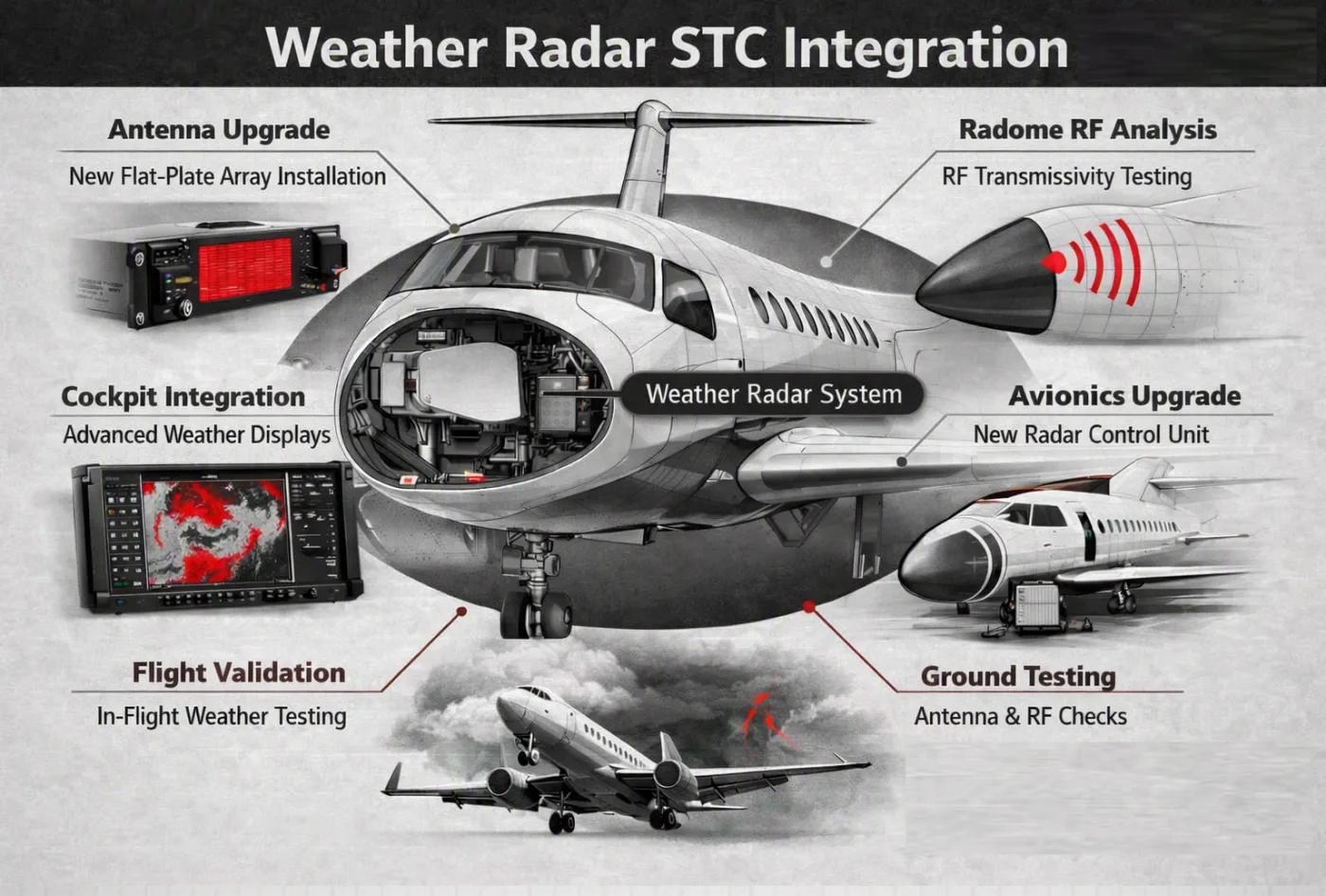
STC Development Considerations:
- Hardware Modernization: The core physical upgrade involves replacing legacy units with modern flat-plate arrays, which strictly requires designing new antenna pedestals and performing localized load analysis on the aircraft’s nose bulkhead.
- Radome RF Substantiation: A uniquely critical requirement for radar is validating radome RF compatibility, ensuring the nose cone’s physical materials allow proper RF transmissivity without excessive signal attenuation.
- Symbology & Display Integration: The radar data must be visually integrated into the cockpit displays specifically integrating the radar’s predictive algorithms for hail, lightning, windshear, and turbulence detection. This requires mapping specific color symbology and ensuring the software interfaces comply with RTCA/DO-178C standards.
- Radar-Specific Ground Verification: On-ground testing is explicitly tailored to radar mechanics, focusing on antenna sweeping functionality, internal BIT/diagnostics, and RF interference checks.
- Meteorological Flight Validation: The ultimate proof of compliance relies on live flight testing specifically dedicated to validating weather cell detection and ground mapping performance under real-world conditions.
2. STC: ADS-B Out
Developing a Supplemental Type Certificate (STC) for an ADS-B Out (Automatic Dependent Surveillance-Broadcast Out) system requires integrating a highly accurate position source with a compliant transponder. Because ADS-B Out broadcasts critical aircraft data to air traffic control and other aircraft, the certification heavily focuses on data integrity, latency, and signal performance
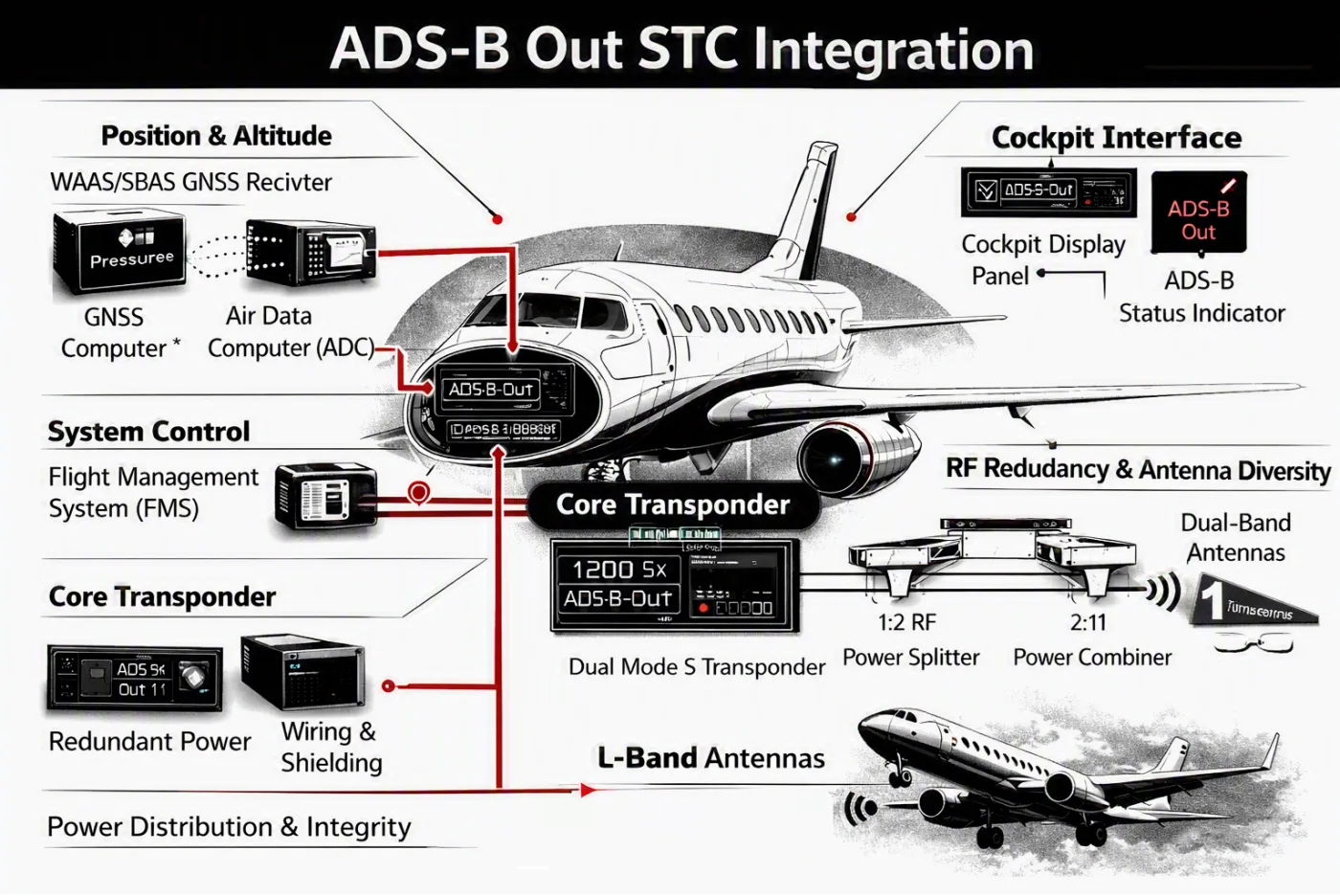
Core Signal Inputs & Processing
- Position & Altitude: The architecture requires a WAAS/SBAS GNSS Receiver to provide the high-accuracy position data mandatory for FAR 91.227 compliance, alongside an Air Data Computer (ADC) for critical pressure altitude data.
- System Control: The Flight Management System (FMS) feeds squawk codes and ident discretes to the core processor.
- Core Transponder: A Dual Mode S Transponder serves as the heart of the system, handling ADS-B message generation and protocol management.
Power Distribution & Integrity
- Redundant Power
- Wiring & Shielding
RF Redundancy & Antenna Diversity
- Signal Routing: The system uses 1:2 RF Power Splitters to distribute transmit signals to multiple antennas, and 2:1 Power Combiners to merge receive signals for diversity systems.
- L-Band Antennas: keep signal loss below 3.0dB.
Cockpit Interface
- The transponder interfaces with a Cockpit Display Panel and an ADS-B Status Indicator,